
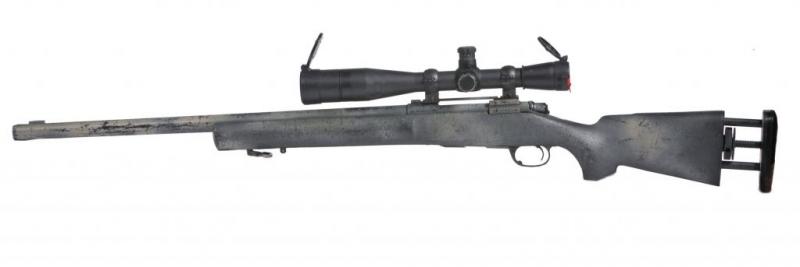
Description
Remington Arms was awarded a contract by the US Army to improve M24 Sniper Weapon. The new M24E1 will get a complete new stock design, new scope and a new suppressor. Remington will upgrade up to 3600 M24 snipers for a price of 28.2 million dollars. Remington has manufactured the M24 sniper rifle for 22 years, producing nearly 15,000 rifles.
Press release: "Remington has a 22-year tradition of manufacturing long-range precision sniper rifles for the U.S. military and this award demonstrates Remington’s continued leadership in the art of producing sniper rifles for military applications. The M24 SWS was competitively selected by the Army as its first purpose-built sniper rifle on 27 July 1988, and the first 100 production systems were fielded on 25 October 1988. Thus far, Remington has produced nearly 15,000 M24 Sniper Weapon Systems, and the M24 is still produced today. Each rifle is tested to meet (and typically exceeds) the requirement to fire 1 minute-of-angle (less than 2-inch group at 200 yards) before being released for fielding. Remington is the military depot-level maintenance facility for the M24 for repairs and overhauls of hundreds of fielded systems each year for the Army, other military services, agencies, and nations."
more info about the contract here: http://www.littlefallstimes.com/topstories/x995830273/Remington-receives-contract-to-upgrade-M24-sniper-rifles...
and here: http://guns.com/component/content/article/60.html...
More about M24 Sniper system from Wikipedia:
The M24 Sniper Weapon System (SWS) is the military and police version of the Remington 700 rifle, M24 being the model name assigned by the United States Army after adoption as their standard sniper rifle in 1988. It is also used by the Israeli Defence Forces. The M24 is referred to as a "weapons system" because it consists of not only a rifle, but also a detachable telescopic sight and other accessories.
The M24 was designed to use the "long-action" version of the Remington M700 BDL. This was chosen because the Army wanted the ability to rebarrel the rifle from 7.62 NATO to the .300 Winchester Magnum cartridge if needed, which required a long action receiver.[2][3] Due to using a short action cartridge in a long action receiver and magazine box, rounds must be pushed to the rear of the magazine in order to ensure reliable feeding.
It originally came tapped for the Leupold Ultra M3 10x40mm fixed-power scope, which came with a circle-shaped etched-glass reticle. This was later replaced in 1998 by the cheaper Leupold Mk.4 LR/T M3 10x40mm first focal plane fixed-power scope with a mil-dot reticle.[4]
N.B.: The first number is the scope's magnification (10) and the second number in millimeters (40mm) is the diameter of the objective lens. A fixed power scope has only one magnification (e.g., 10x) and a variable power scope can be adjusted to focus between a range of magnifications (e.g., 3-9x is adjustable from a minimum power of 3x to a maximum power of 9x).
It comes with a detachable Harris 6-9" BRM-S swivel bipod unit.
The M24 SWS was to be replaced with the M110 Semi-Automatic Sniper System, a contract awarded to Knight's Armament Company. However, the Army still continued to acquire M24s from Remington until February 2010 and the M24 is being upgraded to the A2 and M24E1 standard in many cases, and continues to serve.[5]
Sights: Leupold Ultra M3 10 x 40mm fixed power, Leupold Ultra M3A 10 x 40mm fixed power, or Leupold Mk.4 LR/T M3 10 x 40mm fixed power scope. Detachable emergency Redfield-Palma International back-up iron sights, fitted with tabs that fit into slots machined into the front and back of the barrel.
Barrel: Made of 416R Stainless Steel. The bore twist is 1-turn-in-11.25 inches [1:285.75 mm] and the rifling is 5 radial lands and grooves (5-R) with a right-hand (RH) twist. Because of the odd number of lands, none of the lands are 180° apart, i.e. in direct opposition. This results in less bullet deformation, which (at least in theory) produces more consistent point of impact. In 5-R rifling, the "side" of the land is cut a a 65° angle, rather than 90° in conventional rifling. This results in less barrel fouling, and more consistent point of impact, compared to conventional rifling when relatively high numbers of rounds are fired between cleaning, as might be expected in military applications.
Stock: H-S Precision PST-11 stock. The stock secures the barrel via an aluminum bedding block to keep it rigid. A twin-strut extension that pulls out of the butt is adjustable for a 2-inch [50.8mm] length-of-pull. This is effected by a thick wheel on a central grooved pillar for adjusting the length and a thin locking ring behind it locks the thick wheel in place. The latter is notorious for failing, causing the extension to slide back and forth. Also a styrofoam core designed to reduce the stock's weight would absorb water if it was carried in the rain or soaked in a stream or river, making the weapon heavy and unbalanced.
Accuracy: According to MIL-R-71126(AR), the M24 shall achieve the accuracy results stated below when using M118 Special Ball and fired from a Government approved machine rest. The average mean radius shall be less than or equal to the following values:[1]
200 yards (182.9 m): 1.3 inches
200 metres (218.7 yd): 1.4 inches
300 yards (274.3 m): 1.9 inches
Maximum effective range is given as 875 yards (800 meters), but record shots have been made with the M24 at over 1,000 metres (1,094 yd). Meanwhile, the standard optical sight has a maximum elevation adjustment of 1,000 metres (1,094 yd).
click here to read more about M24 from Wikipedia http://en.wikipedia.org/wiki/M24_Sniper_Weapon_System...
trtrtr





Only $7833.33 each. What a bargain!