
Primary Arms SLX RS-10 - Budget Pistol MRDS, It's Close
Updated
44 months ago
Good morning everyone, hope you're all having a wonderful day, today we're taking a look at the fairly new Primary Arms SLX RS10.
Full disclosure on this Primary Arms optic, I am a dealer for Primary Arms optics, so I do buy a lot of their stuff at reduced prices. On top of that, they also work with me personally and occasionally send me stuff to review. This optic was an optic that I picked up for, again, a reduced price, I did pay my own money for it, but again, just be aware that there is that relationship there.
Wikiarms.com Search Engine Results
Want to see your products here? Click this
link.
 Powered by Wikiarms.com
Getting into the optic itself, this is a micro Red Dot designed to work on handguns, so it also comes with a low mount for using it on a Picatinny gun, riser, offset, that sort of thing. Starting out with the footprint and mounting system on the RS10, unfortunately, this is a Docter/Noblex, I believe, mounting pattern, which means that it is a little bit more finicky to get mounted to certain guns. For instance, here, this is a direct milled RMR slide, so I actually picked up an adapter plate, a fairly thick aluminum adapter plate from, I believe Optics Factory, to get this Docter to fit on an RMR pattern slide, and I also had to remove my rear sight because of just some of the intricacies of how the Docter differs from RMR.

Docter is not quite as popular, so I kind of wish they would have just gone with an RMR footprint, that's my favorite, that's what I've used the most, but again, it is a different footprint, if you have a handgun that natively accepts Docter or some of the multiple adapter systems that are out there, it will probably work just fine.
On top of that, they also include a direct adapter for an MOS system, so if you have a Glock MOS that has their adapter plate system, they do have an adapter specifically for the RS10 to direct mount to an MOS Glock, which is a nice touch to have, if you are running an MOS Glock it will fit right on there to steel adapter plate, fairly high quality, and it is included for the low price of, I believe, 199 on these optics, so probably, on sale, they'll go down to around 150-175, somewhere in that range.
Wikiarms.com Search Engine Results
Want to see your products here? Click this
link.
See more results
for Glock MOS on Wikiarms.com
Powered by Wikiarms.com
In terms of construction, we do have a true 7075 T6 aluminum construction, which is preferred for more duty-grade, or at least more durable optic design. 7075 is about twice the strength, the weight ratio as 6061, depending how it is used, so 7075 is what we like to see on these micro style red dots.
On top of that, in terms of the actual design itself, it is a fairly beefy design, not quite as thick as some of the Holosuns and other optics that are really known for being fairly tough in terms of the body construction. However, the hood itself is fairly thick, it has two raised sections, one at the front, one at the back, for protecting the lens and to kind of keep some of that weight and force away from the lenses. In theory, this can be a little bit more durable than some other optics on the market.
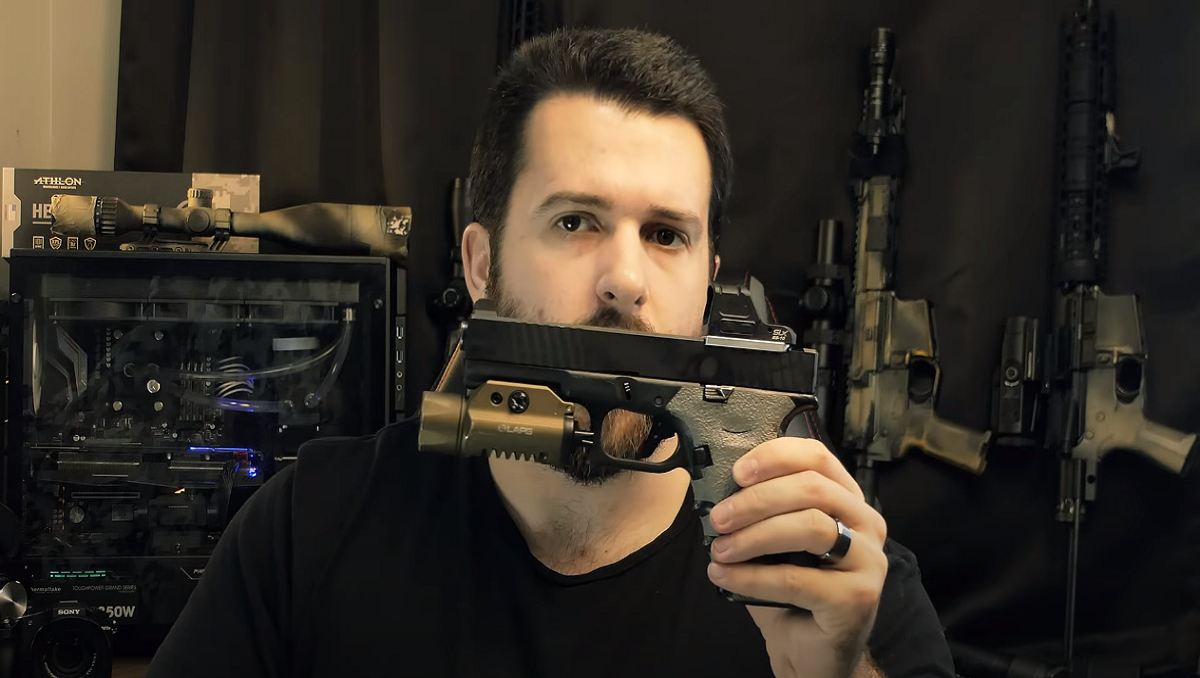
Personally, I have dropped this a couple times accidentally, I didn't do any specific drop testing on the optic, I'm fairly confident that it would pass at least they drop onto dirt and rocks. However, concrete or an AR 500 steel target, something like that would probably do the optic in, If not the first time then maybe the second, so on and so forth. While the design itself, on paper, looks good, it's still not necessarily the most durable optic design out there, though again, at least so far, it has been decent.
Getting into some of the other feature sets of the optic, we do have Primary Arms Auto Live technology, which is just an auto-on/auto-off. After a certain amount of time, it will automatically shut off and then it will turn back on once it senses motion. On top of that, that is combined with a rated battery life of about 40 000 hours that’s probably at a medium setting more realistically or somewhere around 10 000 hours, so again, with auto-on/auto-off that is 10 000 hours of carrying the gun, and if it's just sitting in your safe, sitting at home somewhere, it's going to be off for all of that time, you get a lot of use out of the optic. That is with a 2032 battery that is very interestingly in this side-loading battery door almost, so it kind of has a hinge design on it loosen that and. It has a single screw that holds in the battery tray, that kind of hinges out, and then you have your 2032 battery on the inside.
That design in and of itself is actually quite nice, it does have an O-ring seal or kind of a rubber grommet here on the inside. In theory, that would provide you a level of waterproofing, I don't remember the exact rating, I think it's IPX67, I could be wrong about that though, but it is a very nice design, that allows you to swap the batteries without taking the handgun or the optic off the handgun, meaning that you don't have to re-zero it. On top of that, you have a very good battery life combined with auto-on/auto-off technology.
Getting into other external features on the optic itself, you have two buttons on the left hand side for going up and down in terms of your illumination settings. I believe you have nine daylight settings and two night vision settings, fairly standard for most micro dots, and then we have our windage and elevation. Very nicely on the widget and elevation, rather than being a micro Allen key, which is kind of annoying to adjust, they actually have a fairly deep cutout for a flat head, so if you're using an edge of a case, or something like that, if you needed to make adjustments in the field and didn't have your micro Allen key kit on you, you could still make adjustments with the optic, which is a nice feature to have, it's much easier to adjust then those very annoying micro Allen Keys.

The glass quality itself is pretty decent, you can tell that it does have some warping of the actual image itself If you rotate it in front of your face, you can kind of see the image shift and move a little bit, it's not the most perfect flat image out there. Magnification is very, very minimal, it does look very good in that regard, does have a bit of a blue tint, a bit of a notch filter on it, to increase the battery life, to increase the contrast of the dot itself.
Speaking of the dot, it is a very simple 3 MOA Dot, perfectly fine for me, anything between a three and a six MOA dot on a handgun is very appropriate. The dot itself looks good, it's fairly crisp, and it does definitely get daylight bright, at least in every environment that I put it in, it has been more than bright enough. It does usually, and at the appropriate brightness settings, for instance, on a lot of other red dots they have a setting above, one or even two settings above true daylight bright that is basically for like a white out condition or something like that. This optic on maximum brightness gets daylight bright and appropriately bright, so I don't need an extra setting, but some other optics have a little bit more brightness headroom, depending on how you prefer to run your optics.
Getting into one of the biggest downsides of this optic other than the mounting system, personally, I use RMR a lot more than I do Docter, and so getting an adapter plates a little bit annoying, but that's a personal thing, if you have an optic or a gun that natively accepts Docter, then this is going to be no problem for you.
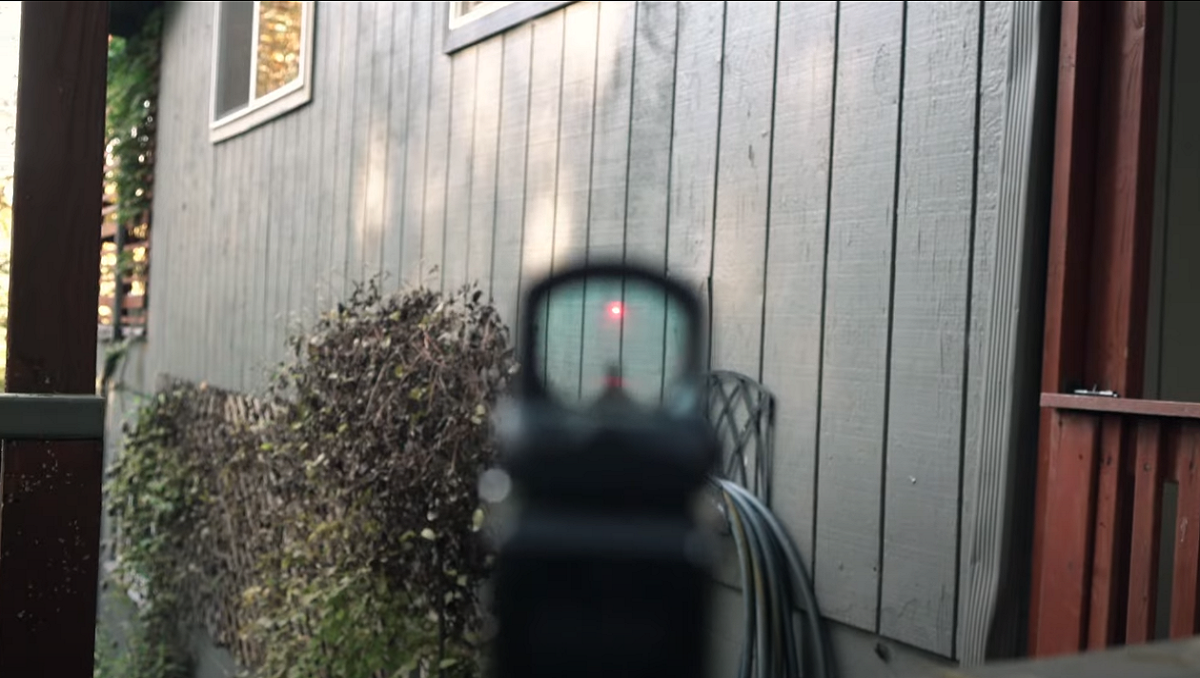
Getting into the biggest problem that I personally have with the RS10 is that emitter refresh rate is really bad. For instance, normally, when you have a good red dot with a good refresh rate, it will look like a very solid laser-like image without a lot of breaking as you move transition from target to target or just move it around in front of your face.
The RS10 has one of these slower emitter refresh rates on the market, much worse than every Holosun dot out there and basically every other handgun red dot that I've tried. It is very noticeably bad. It doesn't necessarily get better or worse as it moves up or down the brightness level, some optics will have their refresh rate married to the brightness setting, so as you get higher in the brightness settings the refresh rate will actually improve. With this one, even on maximum brightness it is still a very choppy dot.
When I'm actually shooting it outdoors, if we get into performance, it is still a usable dot, it does have a 23-millimeter window, which is a fairly decent size. I want to say, it's just a hair bigger than your Holosun 407 and 507 full size dots, so in terms of the window size itself, it is a very decent window size, the image is crisp enough, it does have a little bit of that blue notch filter, a little bit of warping if you're moving it around in front of your face, but overall, the image quality is good, it's a very usable dot.
One thing that you will notice, especially during recoil, if you're firing multiple rounds in a string, is you'll notice that the dot is flickering, so if you're really paying attention to the dot you will notice that it is flickering as it moves up and down in the window and then as you're transitioning to targets it'll look like a little bit of a streaking dot, broken up, you can kind of see where it's turning on and off. It is a downside to the optic. Depending on how you use it, depending on your personal preferences, it could be a really big issue and a complete deal breaker, or you cannot really care.
In terms of performance, I wouldn't really say that it held me back other than the fact that it is noticeable, so it was something that my brain was picking up as I was using it, that it does have a sub-par emitter refresh rate. The dot itself is crisp, it looks nice enough, it just has a very slow emitter refresh rate and something that is noticeable, it's a definite downside. For me personally, not a deal breaker, but if it's going to be around the same price as other optics that don't have that issue, and have a very similar feature set, then I'm probably still going to buy those other dots, especially if they are RMR footprint, which is my personal favorite. That's not really a complaint of the RS10.
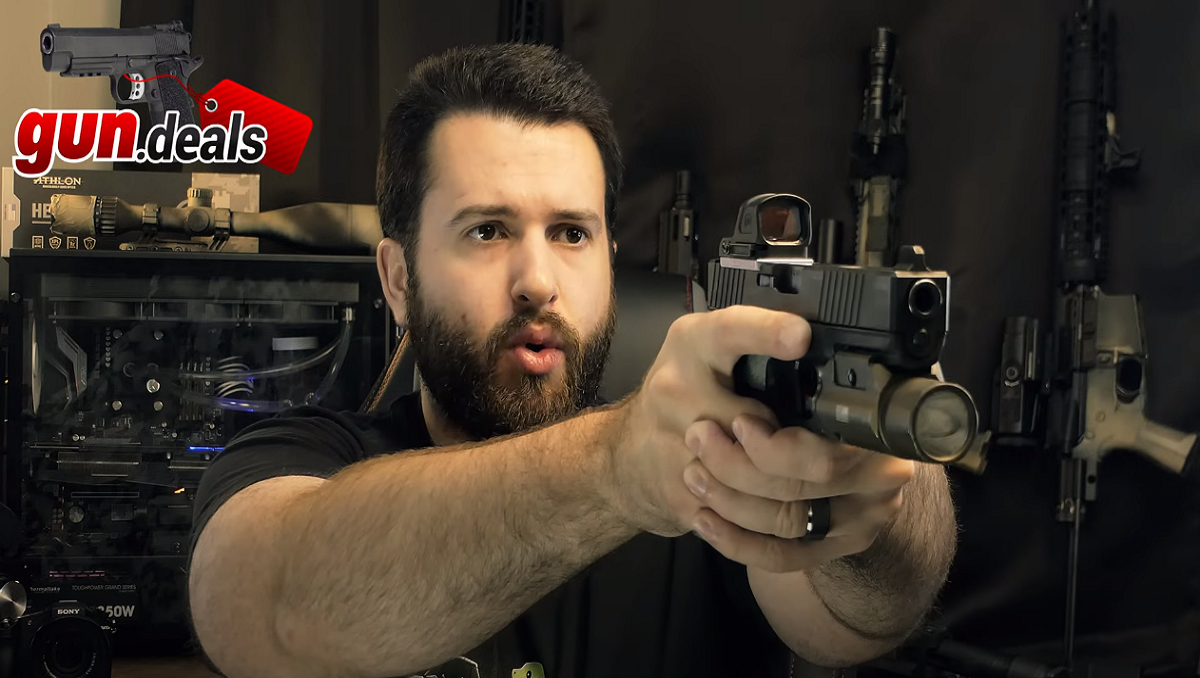
The best part of the SLX RS10 is that very attractive price point coming in at $200 or less in a lot of cases. That is a very attractive price point, I think that Primary Arms did a really good job with getting basically every feature you could want for $200 or less. I do think that it needs an emitter upgrade or just a kind of inline refresh, if you will, to fix that emitter refresh rate issue, and if they did that then it would be a basically perfect optic if you have something that accepts a Docter footprint optic.
As it stands right now, I think it is a good option if you're looking for a Docter footprint optic at around $200 or less, I think that it is a very good option, with a downside or two.
What I would recommend for most people, unless you need something right now, is just to kind of wait till they do a little bit of an update to it, a little bit of an upgrade, because if it's still coming in at around that $200 price point, I think an upgrade of this optic, which is already fairly decent, would be a very good, very compelling option at that $200 price point.
I'm very glad that Primary Arms came out with their SLX lineup of red dots, I think that they just need a little bit of improvement, and it will be a very good product line in the futures, especially if they do something like a GLX as well, with like a super durable finish or something like that, could be very interesting.
As it stands, SLX, their entry level red dot, they also have their classic series of red dots which are certainly not duty-rated, they have a much different feature set as well, totally different optic design, but for the SLX lineup I think that it has a very, very good starting point, it's almost a very compelling buy, and certainly, in the future, probably will be a very compelling buy.