
Northtac Ronin P10 - Super Budget Low Dot
Updated
46 months ago
Good morning, everyone, this is John with gun.deals, and today we’re taking a look at one of the last red dots from Northtac, this is the Northtac Ronin P10.
Getting into full disclosure on the Northtac Ronin P10, Northtac did send us a full lineup of their optics, basically everything except for the V10, I believe, so we got the P10, the P11, which is right here, and the P12. On top of that, we also got the M10, which is back there on the bullpup shotgun.
Getting into their optic lineup, starting out with the P10, depending on where this actually comes out in the video schedule, you may have already seen several of those other videos or this may be the first one, so the P10 is the integrated low mount version, meaning that it is perfect for AKs or other guns that already have a very low comb height, so you don’t need a riser like you would on an AR-15 usually, so it does have an integrated low mount, and then it come with a Picatinny riser, however, because it has an integrated one-piece low mount, which is very strong and durable, it does make it a very good option for AKs or similar style of guns.

They also have the P11, which is an integrated high mount, so the body is one-piece and the mount is a fixed, I believe, one-third co-witness, then they have the P12, which is kind of like your standard T1/T2 style optic, where it has a T1/T2 base, so you can swap out this mount to whatever your heart desires, then they also have the M10, which is the big boxy red dot, and they have a V10, which is the 30-millimeter style red dot, which we do not have in for testing or evaluation.
Wikiarms.com Search Engine Results
Want to see your products here? Click this
link.
 Powered by Wikiarms.com
So, getting into some of the specifics on the P10 model, this comes with an integrated low mount, which is the best in terms of durability, strength and simplicity, if you don’t need a riser. If you do need a riser then you should probably go with the P11 or P12, depending on exactly what you’re looking for.
These optics are often under a hundred dollars, I think the retail price is like 99 dollars and you can find them on sale for like 90 dollars or sometimes a little bit below that, meaning that they are a very economical option, given their features and performance.
Getting into the specifics of the P10, we, of course, have a very simple 2 MOA red dot, which is perfectly fine, it is very usable from everything from zero yards all the way out to about 300 yards, doesn’t necessarily have all the bells and whistles of other reticle systems, but a 2 MOA dot, for 99% of applications out there that you’re gonna be using a red dot for, is perfectly fine.

We have 12 daylight settings on here, it is not night vision compatible as far as I can tell. On top we have our two controls, which are plus and a minus button that do plus and minus things. The battery tray on the right hand side is for a 2432 battery, and most importantly, it has a 50 000 hours battery life, combined with auto ON/auto OFF technology, meaning that if after every few minutes of not touching the optic, it will automatically turn off, conserving that battery life, then when you pick it up and go use it, it is already back on.
Getting into emitter and glass quality, kind of like I mentioned on the other optics, when you’re at the top end brightness settings, so 10, 11, or 12, the refresh rate is very good on the emitter itself, it looks like a very fine laser beam, however, when you go down a few steps in brightness, the dot gets a lot more choppy and you can definitely watch the refresh rate as you’re moving from target to target.
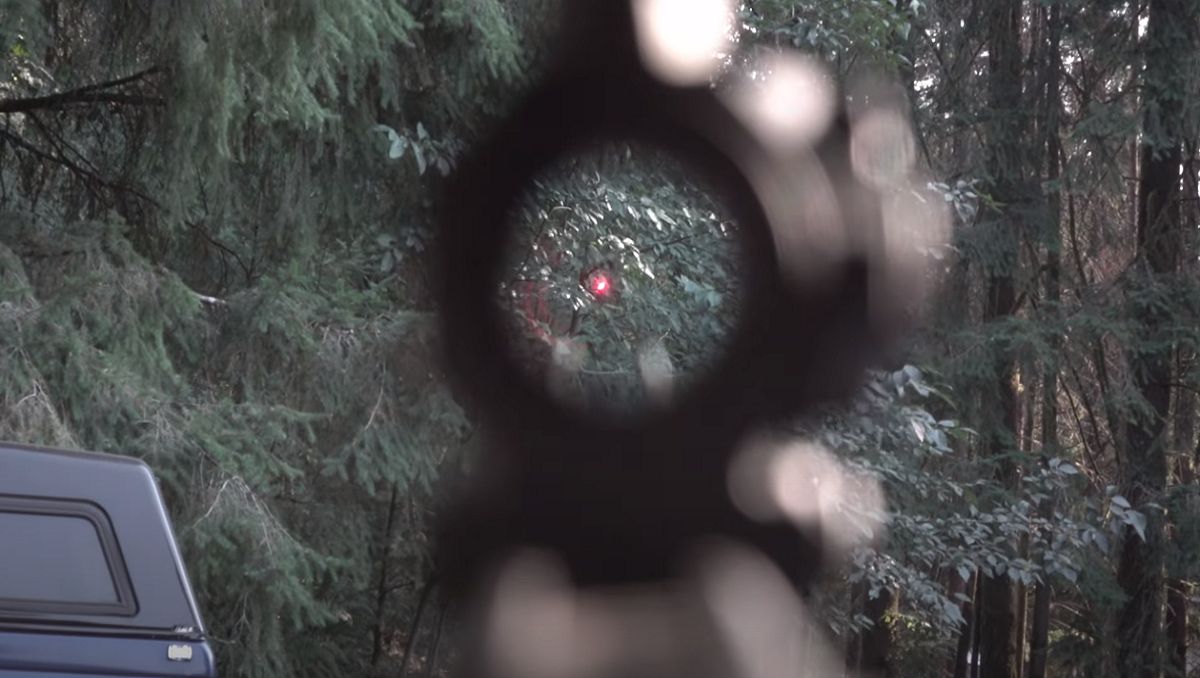
Because this isn’t a night style of optic and you’re gonna be using it outside, in theoretically full daylight or white light situations, if you will, you’re gonna have it on one of the higher brightness levels anyways, so it’s not a large issue, it is something worth noting.
The glass quality itself, it does have a little bit of a blue-ish-green notch filter to it, which is very standard for the price category that it’s in. The image looks pretty flat, there’s no sort of warping around the edges, very, very minor magnification, if any, so the glass quality, dot quality, emitter, all that are perfectly fine, especially when we are talking about a red dot that is this cheap.
Externally, on the body, there’s really only a couple other things to talk about, we have capped windage and elevation, they are in ½ MOA increments, they’re fairly nicely protected by these raised aluminum ridges, and also we’ll get into in just a minute, it was also fairly durable.
Whenever we’re talking about budget optics we’re always gonna be a little bit concerned with their quality control and are they actually going to hold zero, are they going to die after a month or two or six months or a year, there’s a lot of question marks when it comes to their build quality because when we’re talking about cheap red dots, or cheap anything really, they do have to cut corners somewhere, so is that in assembly, is that in quality controls, is that in the actual materials and parts in the construction of the red dot, so there are going to be some of those question marks.
With the Ronin P10 we did submit it to a double drop test, so basically we had a steel setup at about 100 yards and we did a shoulder height drop onto dirt and rocks, reconfirmed zero that it was still hitting on target, did another drop test after that, confirmed again that it was still hitting on target, and it did pass with flying colors.

I didn’t really check for exact zero shift on it because this is mounted to the KR9, which is mounted to a dust cover which does have a little bit of movement to it, not much, so it’s not necessarily the best zero retaining platform on the market, however, inside of 100 yards, perfectly acceptable, the optic body itself did take some damage, the elevation net cap took some damage as well, but no issues with the glass, emitter or anything else like that failing on the optic.
So, that is a pretty harsh impact, shoulder height onto dirt and rocks is not the hardest impact in the world, but it’s definitely a lot harder than a lot of what most people will run into with their optics during normal use, so it is nice to see that it was able to retain zero, but also not straight up die during a drop test.
So, with the P10, much like what I said about the P12, is that it does provide you an acceptable level of performance and an acceptable level of quality when compared with the price. So, a very good budget red dot is a SIG Romeo 5, it is basically the gold standard of budget dots, whether you think it’s the Holosun 403 or the Vortex Crossfire, whatever they call it, they’re all very good budget red dots that can be found for the low 100$ price category.
This is going to be maybe a little bit worse in terms of performance, especially when it comes to dot quality and emitter quality, however, it’s also gonna be about 20$ cheaper, so it is going to be that step below into that kind of super budget category, if you will, and a lot of people are looking for that sub 100$ price tag, and for that sub 100$ price tag Northtac is providing you and acceptable level of quality and an acceptable performance level.

In fact, the performance of the optic is perfectly fine, in normal daylight you’re never gonna notice the refresh rate issue on the emitter because you’re gonna be at 10, 11 or 12 anyways, and it does work perfectly fine, it will take a hit and keep going. Now, will it work over six months, a year, two, five years, so on and so forth, that is where it’s going to need to be continually evaluated over time, so perhaps the end of next year or so we’ll do an updated video on all their optics that we have in for testing and see if they’re still holding up the snuff.