
A Good Budget Dot Made Better, Primary Arms MD 25 G2 - ACSS CQB and 2 MOA Dot
Updated
39 months ago
Good morning, everyone, this is John with gun.deals, and today we're going to be taking a look at the refreshed and updated Primary Arms MD 25 Gen 2. I actually have both the ACSS CQB version and the simple 2 MOA dot version here to review and talk about.
Wikiarms.com Search Engine Results
Want to see your products here? Click this
link.
 Powered by Wikiarms.com
Full disclosure on both of these red dots is that I have a working relationship with Primary Arms, they sent out both of these red dots to me to review for free so I did not pay for them whatsoever, so just keep that in mind going forward that I do have a relationship with Primary Arms and they send me stuff for free.
Getting into the specifics of the red dot, as the name implies, the MD 25, this is a slightly increased size red dot, so instead of like your standard micro red dots 8.21 T2 style of red dots, this is going to be a 25- millimeter window versus a 20-millimeter window, what that means is you get a little bit more room through the glass itself, which some people might find preferable. I am somebody who does like larger window red dots. Other red dots that have big windows I do tend to be a fan of, it's not necessarily that that it will actually increase your performance, because we're all shooting with both eyes open so you're going to see everything anyways, but sometimes it is nice to see more through the glass itself versus like looking through a tiny little tube, that might obstruct some things right around your target, so having a little bit more room around your target through the glass itself, some people might like that and I do tend to be one of those people, though that is definitely going to be a personal preference thing, not necessarily something that just everybody needs.
Getting into specifics on the MD 25, we have a 25-millimeter objective lens, this one here is the ACSS CQB reticle, which we'll go into a little bit more detail later on. The body itself is I believe 6061 T6 aluminum, very standard there. In terms of size and weight it is about three inches long, about two inches wide with the battery cap and the windage cap, and comes in at a weight of 6.5 ounces.

When we talk about the mount it is, fortunately, your standard T1, T2 style of mount, so most or if not all of your aftermarket T1, T2 mounts will absolutely fit so you can get it to whatever height that you want, however, it does come with a low mount, with an absolute, so a 141, 154, and 163 as well, so it comes with the low mount, the standard absolute, and then two different riser plates to get you to whatever height that you want, if you want a super tall mount like a 175, 193, so on and so forth, you can get a aftermarket T1, T2 style mount, but it does come with a lot of different mounting options in the box, currently it is at the lower 1/3 or 163 that I do tend to prefer if not a little bit taller because I am using a half inch riser on top of that for the red dot and the magnifier.
Fortunately, the mount design itself is fairly good, you have two large steel crossbolts that thread into steel inserts on the other side, a very large locking block, two recoil lugs on the bottom of the mount itself, so you get a lot of contact on your rail, the recoil lugs provide a hard stop during recoil, so you have the best chance possible of retaining zero after a sharp impact, which we did test, and we'll get into that a little bit later on.
As far as controls go, on the left hand side we have our battery tray and our illumination settings, which will go all the way from 0 to 11, the first two settings are night vision settings, I have not tested those, I do not have nods so I do not know how well those work. Presumably, there is some circumstance in which they will work fine, though only two of them, from what I've heard, can tend to be an issue, especially when we're talking about a very large reticle like this, if it's a little bit too bright it'll start to bloom out super fast because there's a lot going on with this reticle. Fortunately, for the rest of the daylight settings or the rest of the normal settings, 11 is very bright and if you don't need that you can always dial it back just a little bit, but it does get more than daylight bright.

Updated in the Gen 2, the newest Improvement to them is going to be the fact that these now come standard with auto live technology, meaning that they will shut off after a certain amount of time and then turn back on. With the ACSS CQB version the battery life is rated at 12 000 hours at a medium setting, so probably think five to seven thousand hours in a more usable brightness setting, so a higher brightness setting, seven, eight, nine, ten, eleven, something like that, but because it has Auto/on-Auto/off it turns off I believe after 15 minutes or so, once it turns off it's saving that battery life, so really you're looking at five to seven thousand hours of use of the battery or of the optic, which means that you probably are getting one to two years if not more depending on how much you're actually using it. I've had these optics for quite some time now since they came out, so three, four months at this point and the auto live has been perfect, every time I pick it up it's already on to the last setting because it just saves the last setting that you use and it works perfectly fine.
I know on the original versions that did not have auto live technology people were going through batteries basically every month, which is not too much fun if you forget to turn your red dot off and you pick it up a couple weeks later and your battery is dead, never a fun thing to run into, but, fortunately, that issue is completely removed with the Gen 2 version, not that the battery life is fantastic, but it is quite a bit better than what you're going to get, especially on the Gen 1 version, and certainly going to extend it six months, a year at least.
Important to note, on the 2 MOA version, which is a little bit cheaper, it's a little bit simpler, only using a 2 MOA dot, this one here has a rated battery life I believe a 50 000 hours combined with auto live technologies, Auto/on, Auto/off, so this one here will last basically forever as long as that battery can hold a charge and power and emitter. The 2 MOA dot version is much simpler, it's a little bit cheaper, but other than that the specs are basically the same. This one here is marked up quite a bit, at this point I believe these have encountered six shoulder height drops collectively, four on this one, and then two on the 2 MOA dot version, and they're still working just fine. The 2 MOA dot version is for all intents and purposes exactly the same, mine is the reticle and I believe it's like 10 bucks cheaper, which, depending on your use case for it, maybe that's enough, plus the extended battery life to choose this over the CQB depending on if you need the reticle.

Speaking of the reticle, the last thing that we need to talk about before we get into performance, is the ACSS CQB reticle. This is based off of a center chevron design and a outer horseshoe, so you have a two-thirds horseshoe on the outer side for really quick acquisition, up close, you can basically just put that on a target and pull the trigger and you're going to be getting an acceptable hit, it also doubles as a little bit of auto ranging, so I believe that is kind of standard Buckshot pattern at 25 yards, so you could mount this to a shotgun, which this one here was actually mounted to a shotgun for a little bit of time, so it has some extra auto ranging features in there as well that are nice that you're going to get with ACSS style reticles.
With that center chevron you have a very fine tip that, unfortunately, does not always look good under magnification, sometimes it looks very sharp and very crisp and is very nice to just put somewhere and you can be very precise with it, much more precise than just like a 2 MOA dot. However, sometimes, depending on your magnifier and your diopter settings, sometimes it just does not look very good and I have a perfect vision, no astigmatism, and sometimes it will kind of like wash out or get a little bit wavy depending on what magnifier you're using it, what head position you're in, so on and so forth. When it works optimally it is very good, it is very precise, on top of that, you also have holds for three, four, and 500 yards so you do have some of that distance capability as well, much more than like just a standard red dot without any sort of BDC or auto ranging features. So, when it's working optimally, the ACSS CQB reticle looks very good, it's very sharp, very crisp, very precise, and you do have that extended range capabilities when combined with a magnifier, that is going to make it much easier to get on target at those more extended distances for a red dot.
In maybe half the time I was using it to out to distance or even just in close range, using it for like the drop test for like zeroing and stuff like that and trying to be as precise as possible, depending on my head position and magnifier that I was using, sometimes it would just look a little blurry, and then I'd rather just have a 2 MOA dot, that's not as blurry as like a chevron that's starting to wave out a little bit. Right now, in this configuration, it looks very good, but you might need to play around with it a little bit to find the most optimum settings to make sure that it looks as good as possible for the majority of the time.
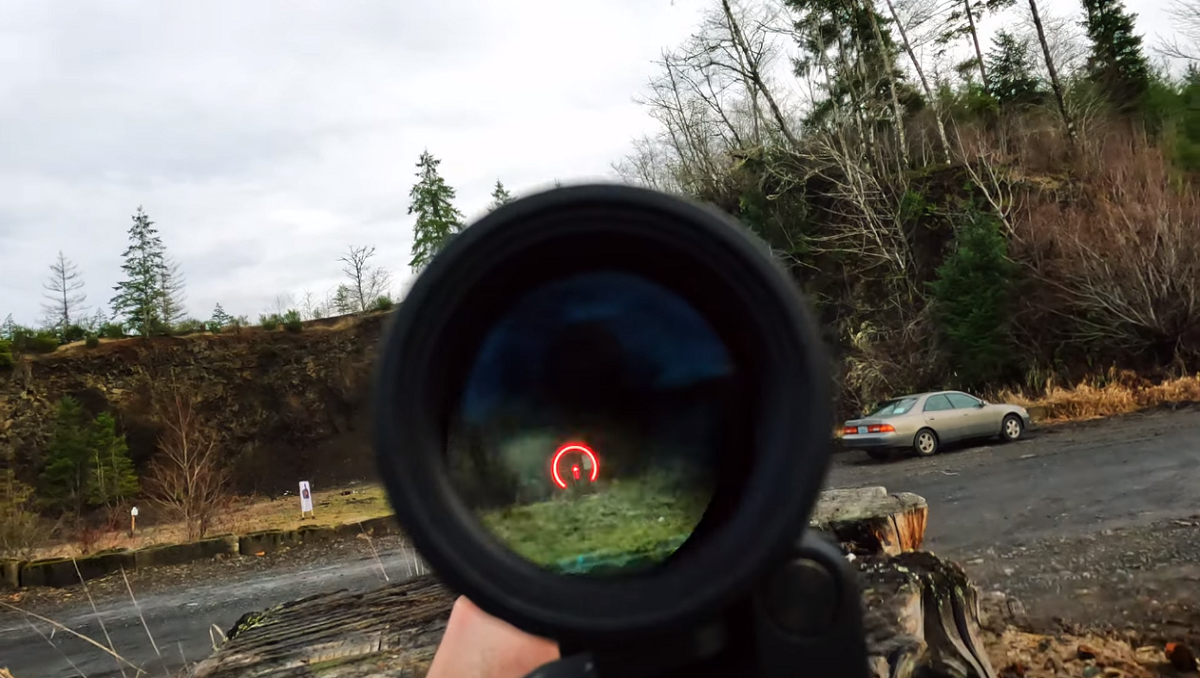
Overall, I do think that the ACSS CQB reticle is done very well, it has basically all the features you could want in a red dot, it's obviously not going to be as complex as some of the other ACSS reticles out there, but for a red dot I think that it works very well, being a good blend of speed and precision, just note that for me, anyways on this one, it didn't always look quite perfect, and so sometimes it would actually be a little bit of a hindrance and I would rather just have a 2 MOA dot, though when it's working perfectly it is very nice.
Getting into the performance of the dot itself, what it was like to actually use this red dot, well it is a bit of a tale of two cities because you do have a slightly larger window, which I do prefer, however, the body of the red dot itself is really, really thick, you have this huge battery tray hanging off on this side and then you have your windage and elevation, so it is a very, very thick red dot. So, yes, you do see a little bit more through it, but then you get a lot more obstructive. If they could make the caps a little bit more low profile, if they could put the battery tray in a different location, maybe on top would have been better honestly, you would get a much more clean sight picture with less obstruction around it, so while it is nice to have a slightly larger window, I do prefer that sort of thing, overall, you end up seeing as little or maybe less than like a 20-millimeter red dot because a 20-millimeter red dot usually is going to be a little bit more low profile in the body, you see a little bit less through the optic itself, but because it's more low profile through the body you get less obstruction, so there is a big trade-off going there.
Not that the MD 25 is unusable by any means, it is perfectly fine to use, combined with a good reticle, decent glass quality, it does have a bit of a blue notch filter to it that is very noticeable, but that's there to help extend that battery life out. Overall, I think using the red dot is perfectly fine, however, using a 20-millimeter red dot is also perfectly fine, so you're getting a bit of a size and weight penalty without much benefit. This reticle in the Holosun 503 G, that might be a much better option than the MD 25 just because you're getting a smaller, lighter footprint with less obstruction, slightly smaller window but you're getting the same reticle, feature set, in a better body style.
Wikiarms.com Search Engine Results
Want to see your products here? Click this
link.
Powered by Wikiarms.com
For me, I would like to see the body redone a little bit, to be a little bit more low profile, I do like the large window design, but the large window design isn't going to help you if the body is then more obstructive, so I'd like to get the best of both worlds instead of a bit of a mixed bag.
Fortunately, when we talk about durability, this is an area where both of the red dots did very well over multiple shoulder high drops, so for instance I've done a video on these, on my personal channel, the Focus trip Channel as well, and they both did very well during those shoulder height drops, and I also did two more shoulder high drops for this video.

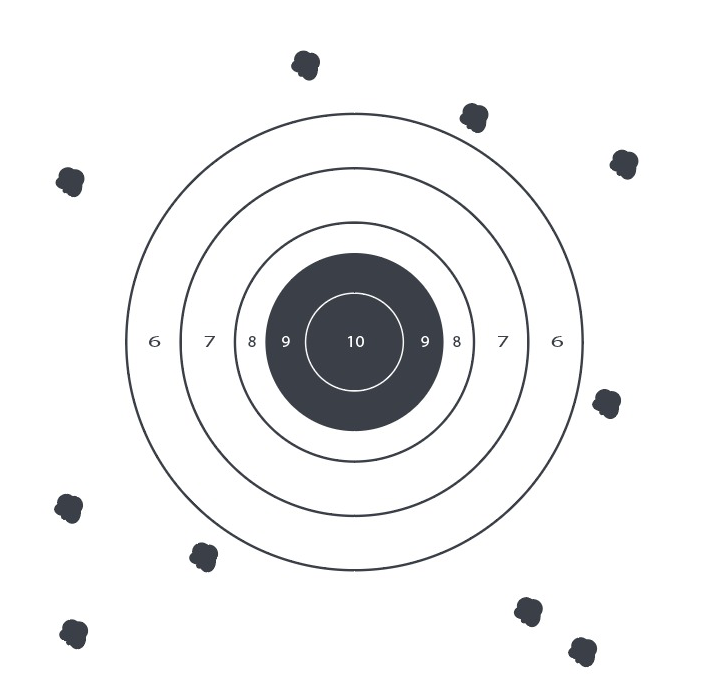
So, starting off, we do a five round control group at I believe 50 yards for these, and then we go ahead and do one shoulder height drop onto dirt and rocks. The first shoulder high drop perfectly fine, we see about maybe an inch shift in point of impact, so that means that you have about a 2 MOA shift after a shoulder height drop, which is probably the harshest drop that anybody is going to run into in a normal circumstance, and then I went ahead and did another shoulder height drop, this time onto I believe an AR 500 steel plate, then we got about one inch point of impact shift, meaning about 2 MOA. It doesn't hold zero perfectly, but it holds pretty darn well after probably the harshest impacts you're ever going to run into. On top of that, both of the red dots are perfectly fine after about six drops at this point, no issues with either of them in terms of function, both batteries are still going quite strong. So, no issues there, durability does seem to be very good, recoil holding abilities are fine, they're not necessarily the best that I've seen, but they're definitely decent, if you're shooting inside of 100, 200 yards, one, 2 MOA is not going to matter all that much as long as you're doing that your part, but it is just something that you should note that the recoil holding or the zero holding of the optics is very good, if not perfect.
When it comes to the value persuasion, I think that these are both right around the 200-dollar mark, with the CQB ACSS version, being a little bit more expensive. If you already had a Gen 1 MD 25 and you really liked it or all the feature set, using it, the reticle, so on and so forth, but you hated the fact that it didn't have Auto/on, Auto/off, well, this fixes all of those issues. if you don't have one and you don't need the reticle, then it's not necessarily something that I would recommend just straight up switching to, if you already have a good red dot your red dot that you have is going to serve you perfectly fine, and if you're looking for that reticle I personally prefer Holosun 503 G with their ACSS, same reticle, but the Holosun 503 body. That is kind of where I would push you towards if you're looking for that reticle, which is a very good reticle when it's working perfectly.
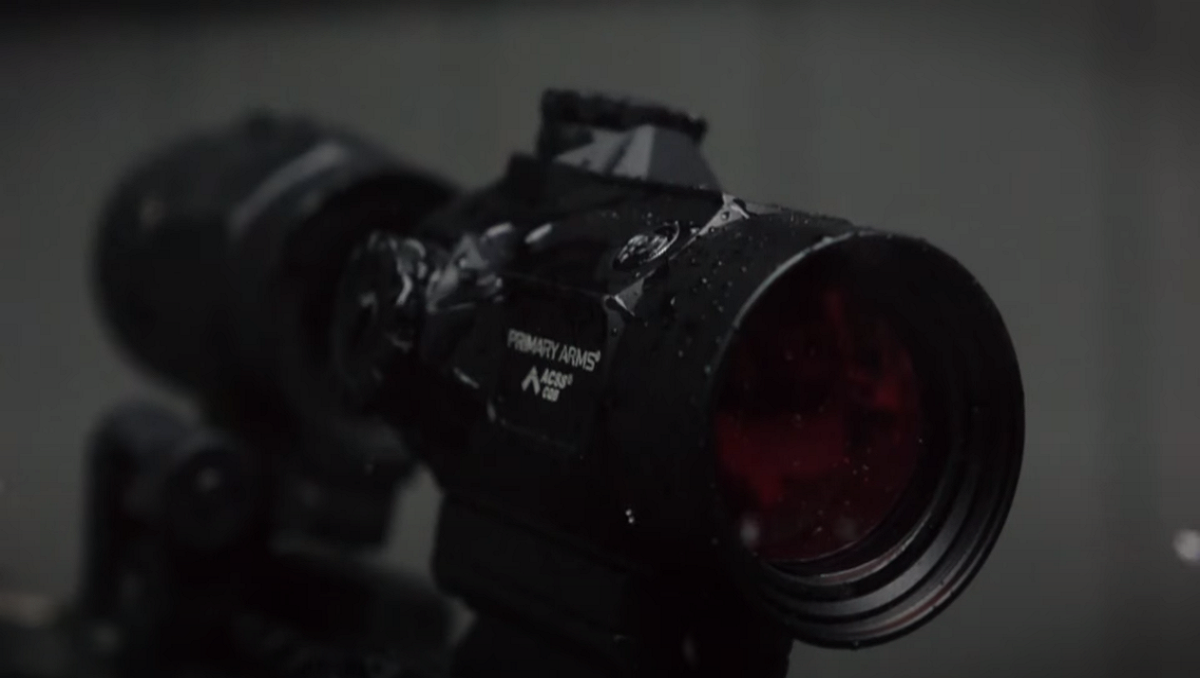
The MD 25 is really only going to be limited to those who really want that bigger body or that bigger optic window and are willing to sacrifice the fact that you have a more obstructive bigger body as well, so it is definitely kind of a trade-off there in terms of window size and then body size.
So, do I think that they're good red dots?
Perfectly fine!
If you find one on a good deal, I know that the Gen ones were on sale for like a hundred bucks, and for 100 bucks they're pretty darn good, they are missing Auto/on, Auto/off technology, which is a little bit frustrating, especially if you just forget to turn them off, they're gonna die on you fairly quickly, especially the ACSS version. Overall, I do think that they are good red dots, they perform quite well, they were easy to use, they're not perfect and they're not necessarily the pinnacle of value, but for some people, if you like the feature set, you like the window size, you don't mind the body, they're going to work just fine for you.
Are they the best for everybody?
I personally don't think so.