
Burris RT6 1-6x LPVO - Still One of the Better Budget LPVOs
Updated
48 months ago
Good morning, everyone, hope you’re all having a wonderful day today. Today we’re gonna be taking a look at the often requested Burris RT6.
Full disclosure on the Burris RT6, we did pay our own money for this optic, however, we paid for it at a wholesale cost, so I believe it was below 300$. So, we don’t have any relationship with Burris or any sort of affiliation for this review, but do keep in mind that we didn’t pay full price for the optic.
Wikiarms.com Search Engine Results
Want to see your products here? Click this
link.
 Powered by Wikiarms.com
Getting into the basics of the Burris RT6, this is one of the most often requested, either directly to review or to compare against other LPVO’s, and it’s something that most people speak highly of, and as we’ll get into the review, it is very easy to understand why because it does all of the LPVO things to a very high level, especially given the price tag.
Getting into the basics, the material is, I believe, 6061 aluminum, which is very standard, we have a 30 millimeter main tube, we have a 24 millimeter objective lens, a 46 millimeter ocular section, which is all fairly standard for the 30 millimeter LPVO game. We have capped windage and elevation turrets, they are half MOA.

The clicks themselves are not really audible, they’re fairly mushy and weak, but for this style of “tactical optic” it is going to be very much so a set and forget type of thing.
It is also illuminated, you have 11 different illumination levels and a 2032 battery. On top of that, you also have an offsetting in between each of your illumination settings, that is very helpful because that makes it a lot easier to remember to turn it off, so that you don’t burn out your battery life.
Battery life on LPVO’s, depending on your settings, of course, is gonna be somewhere between like 20 and 200 hours in most cases. There are a few LPVO’s that have a much higher battery life, but in general the battery life on the illumination settings on the LPVO is very low.

Moving back from here we have, of course, our magnification ring. The magnification ring itself is fairly stiff but smooth, which is how most people would prefer it, it’s a lot harder to accidentally bump it into the wrong magnification, and it comes pre-installed with a throw lever that is large enough to get the job done, very easy to grab in a hurry, if you need to do so. On top of that, it is removable if you need to not use it or if you just like a slimmer sleek look and you want to cut about a half ounce off the weight of the optic.
Moving back from there, the last thing that we have is the focus ring or in this case the diopter, which is going to focus the reticle for your eyes, everybody’s eyes are a little bit different.
The size and weight of the optic is a little bit over 10 inches long and it comes in at a weight of 17.4 ounces, which is actually very good. That means if you’re using some sort of super light mount like the Aero Precision super lightweight mounts you can get a total 1-6 package that comes in right around 20 ounces, which, again, for a 1-6 LPVO is a lot of capability in a very small lightweight, well not really small but definitely a lightweight package.
Currently I have it in a worn 193 mount, as I really like 193 mounts, it’s much more comfortable for my body dynamics, if you will, and so that is generally how I choose to run it.
Wikiarms.com Search Engine Results
Want to see your products here? Click this
link.
See more results
for Aero Precision on Wikiarms.com
Powered by Wikiarms.com
Getting into eye relief, eye box and field of view, the eye relief is stated as like 3.3 inches, though, of course, when we dial it down to 1x we have a very, very forgiving eye relief. The eye box is also very good, you almost have a full inch left, right, up and down, again, on 1x, so that means that you, as long as you can get your eye mostly behind the optic, you’re gonna get somewhat of a sight picture through it.
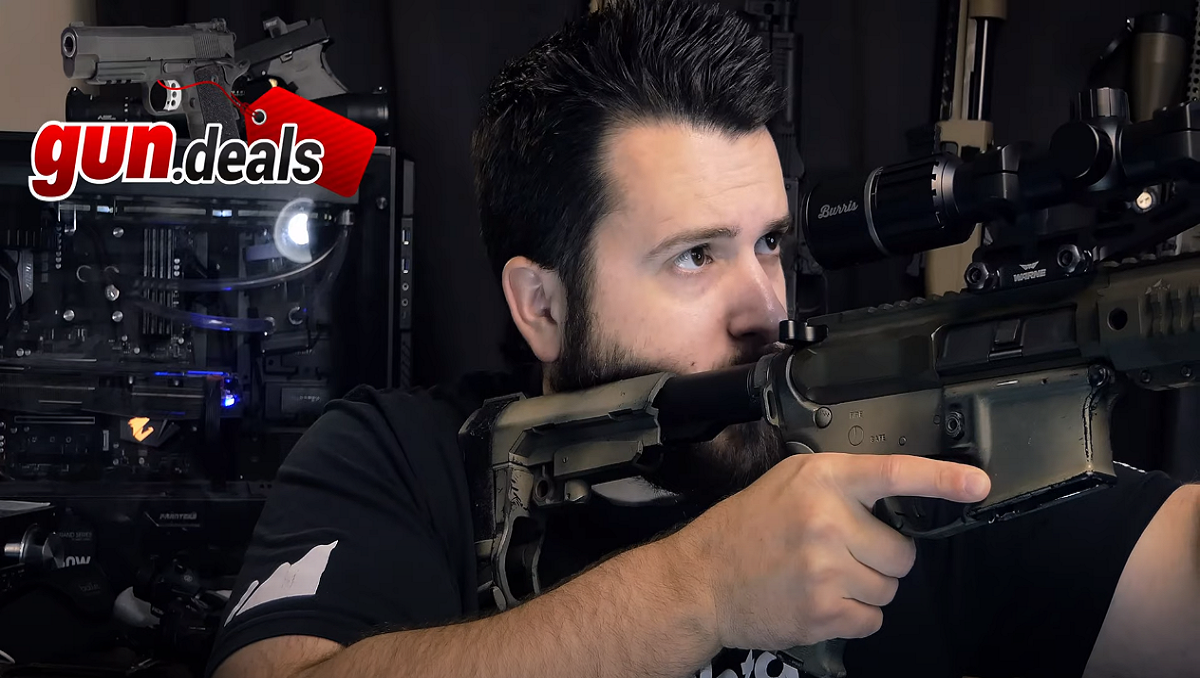
That means that the optic is very usable on 1x, however, of course, when we crank that up to 6x it gets a lot tighter. It’s not insanely tight like it is on some 1-8 or especially 1-10’s, but it is still much tighter than it is on 1x. Still usable, but definitely gonna be a little bit harder to use, you’re gonna need to be in a more stable position, so shooting for more awkward positions is going to be a little bit more difficult.
Getting into the field of view on the Burris RT6, it is rated at 106 feet at 100 yards on 1x. For my personal rating everything above 100 feet of field of view is good, anything above 110 very good, 120 top-tier, phenomenal, so on and so forth.
106 feet, I was honestly a little bit surprised because when I’m behind the optic it feels like there is more field of view because 1x is a very flat, a very pleasant 1x image, there’s not a lot warping or fisheye going on around the edges like on some other LPVO’s that might have a much wider field of view, but the trade-off there is that the 1x image is not as flat, it’s a little bit like a GoPro lens and it’s very wide but very fisheye around the edges, so there’s a lot more distortion.

What you get on the Burris RT6 is, again, a very, very pleasant image, it’s very flat, it looks natural. It’s still not a perfect 1x image because, of course, you’re looking through many panes of glass as opposed to like a red dot or just your naked eyes. So, while it is a good 1x representation and, in fact, a very good 1x representation, it’s still not quite perfect and around the edges you’re gonna be getting into a little bit of color shift/distortion.
When we get into glass quality overall, this is one of the areas where it’s honestly pretty standard with basically every overseas made optic, anything like the Strike Eagle Gen 2’s, anything like the Swampfox arrowheads, and anything really, that’s made over in that same price category, is gonna have a very similar glass quality to the Burris RT6.

Wikiarms.com Search Engine Results
Want to see your products here? Click this
link.
Powered by Wikiarms.com
Wikiarms.com Search Engine Results
Want to see your products here? Click this
link.
Powered by Wikiarms.com
The good thing about that is that all of those optics have just fine glass quality and the Burris RT6 is no different. It’s going to compare with like the Vortex Vipers or anything that has like Japanese or German or USA glass, those are all going to be much, much better in terms clarity, brightness, light transmission, all that sort of fun stuff, but, again, for the price category and its competition, the glass quality is just fine.
Wikiarms.com Search Engine Results
Want to see your products here? Click this
link.
See more results
for Vortex Vipers on Wikiarms.com
Powered by Wikiarms.com
When we combine all those things together we have decent glass quality, we have good 1x performance, which is very important on an LPVO. We have a pretty lightweight package at 17.4 ounces, it’s not too big, it’s not too heavy, you have all the features that you want, illuminated reticle, built-in throw lever, all of those things are very nice, and what a lot of people like the optic.
The next and the last thing to talk about, personally, is what it holds it back from being the top-tier budget LPVO in 2022, and that is going to be the reticle.
The reticle that they call it the ballistic 5x, I’m not sure why they call it the ballistic 5x when it’s 1-6 LPVO, but the reticle itself, while it does have some nice features and it’s definitely usable, it’s just kind of a little bit behind the curve in terms of modern budget LPVO’s.
Getting into the reticle itself, starting with the center section we have a 1MOA dot as our aiming point, personally a 1MOA dot is just fine, it’s a good blend of speed and precision, and, again, this is not a first focal plane reticle, we’re also probably not gonna be dialing, so you’re really only gonna be using that dot out to about 300 yards and then using the BDC the rest of the time.
On the outside of the dot we have our horseshoe or donut of death, whatever you wanna call it, that is also illuminated, the only parts of the reticle that illuminate are the central dot and the horseshoe. For me personally, that’s fine, however, if you’re gonna be taking shots at 3, 4, 5, 600 yards in sort of dusk and not quite dark conditions, then you would prefer, of course, to have the whole reticle illuminated.
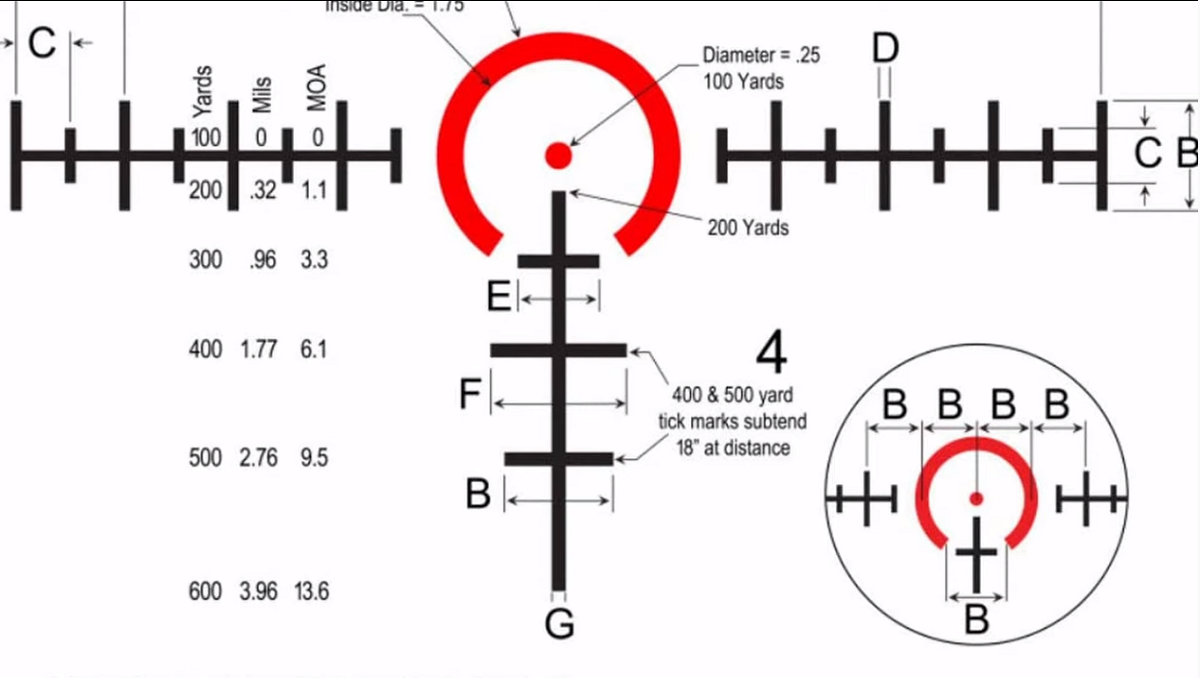
Getting into the BDC itself, we zeroed the optic at 100 yards, then the top of the BDC is going to be 200 yards, the first hash mark 300 yards, 4, 5, and then the bottom is going to be 600 yards.
We were actually able to take this optic out to six and 700 yards on a 14.7 pencil barrel, one of my NSR upper receivers that I personally sell on my website, and the reticle ran out of information very quickly, there’s not really any wind holds built into the reticle, you don’t have all that much information, there’s not a lot of auto-ranging features either, so while the reticle is definitely usable, especially inside of 500 yards, at 6 and, of course, beyond because there’s no information beyond that, it becomes very difficult to use.
For my six and 700-yard shooting I was using 77 grain Atomic ammunition, which is not particularly good ammunition, but it is at least consistent and has a high BC, so at those extended distances when I literally could not use the reticle whatsoever, I would have to reference off of something in the background and just hold there, as opposed to actually using the information within the reticle.
There it is!
Two in a row!
Three in a row!
Four in a row!
By the way, the reticle is out of the space now, I’m Kentucky windaging, I’m finding something in the background to reference the reticle off of.
Oh, there it is!
Again, I’m just holding off into the space, even with the entire BDC reticle, like you don’t have enough info in there to hit it this far, consistently anyways. Now, if you find something good in the background to reference off of maybe, but that’s, again, at a very static target.

Two in a row!
Three in a row!
Four in a row!
We out!
We out, I’m actually pretty happy with that.
That is not a particularly easy or consistent way to get out to extended distances, so while that is a knock on terms of its long-range performance like six, 700 yards, it’s really not designed for that, so if your use case of your specific rifle is like 0-600, 0-700, 0-800, then the Burris RT6 is going to be a little luckluster, especially at those longer distances, and a little bit luckluster in those mid-range distances where you’re dealing with wind as well.
Personally, 5 and 10 mile at hour wind holds are very important on LPVO’s because that’s going to allow you to get those 55, 62 grain 556 projectiles onto target, quickly and accurately instead of having to Kentucky windage everything.
While the reticle is definitely usable, and I’m being hard on the reticle, I know that, it’s definitely usable inside of 500 yards, really not gonna be a problem at all in most scenarios. There are just a lot more modern optics in the same price category that give you auto-ranging features, wind holds, longer BDC’s, so on and so forth, that kind of eclipse the reticle in the Burris RT6.
Well, the overall package that that reticle is in, for the Burris RT6, is very good and I definitely know why a lot of people like it. It is held back just a little bit in certain scenarios, again, windy scenarios or long-distance scenarios by the reticle.

If Burris came out with the exact same scope and literally just changed the reticle a little bit I would have very little to complain about here and it would be a very good buy. As it is, it is a very good optic and I really don’t have any problems with it. For most people, 99% of people, are not taking their LPVO’s beyond 600 yards and very few of them are taking them to 600 yards to begin with.
For most people, if you’re getting a good deal on the Burris RT6 or you already have one, you should be very happy with your purchase, it’s a very good optic, especially for the money, it has all the LPVO downsides, it’s gonna be bigger and heavier than a red dot, but it’s going to provide you a ton of versatility, which is why I personally like LPVO’s.
If you had to ask me today which should I buy, a Strike Eagle Gen 2 for like 300 bucks with a mount, a Swampfox Arrowhead for about 350 without a mount or some other budget-tier LPVO. Honestly, I would probably still go with the Striker Eagle Gen 2’s either the 1-6 or 1-8 models. For the money they’re very good, they have better reticles, the illumination is a little bit brighter, if I didn’t mention. This one doesn’t really get daylight bright or even daylight tinted, you can barely see the red, whereas other, again, more modern optics, the Strike Eagle Gen 2’s, do have a little bit brighter illumination, not that it matters all that much.
So, in 2022 is still a very good option and, again, if you find a good deal on it or already have it, it’s a great optic, no reason to get rid of it or to shy away from purchasing one, however, if you find another competitive optic for a better deal I would probably hop on that one as well.

So, with all of that out of the way, guys, it is a very good LPVO, really only held back by its reticle and only in a few scenarios.