
The Sightmark Optics - Sightmark Wolverine FSR 1x28
Updated
45 months ago
Good morning, everyone, this is John with gun.deals, and today we’re taking a look at the often requested and possibly the best optic that Sightmark makes, this is the Sightmark Wolverine FSR.
Getting into full disclosure on the Sightmark Wolverine, we paid our own money for this optic and we have absolutely no relationship with Sightmark whatsoever.
Wikiarms.com Search Engine Results
Want to see your products here? Click this
link.
 Powered by Wikiarms.com
These optics are fairly budget, they’re definitely in that budget-tier of red dots, you can find them usually for under 150 bucks. Somewhere between 100 and 120 is kind of where you should be looking for if you want to get a good deal on it.
Getting into specifics on the Wolverine, this is the red dot. The FSR is the full-size version and then they have a slightly smaller version of the optic, that’s a little smaller a little lighter, called the CSR, which I imagine is the compact size red dot, this is the full-sized red dot.
The FSR is the one that we’re taking a look today and it is a little bit bigger and heavier than the CSR.

This is a 2 MOA red dot, featuring a purported battery life of up to 1, 000, 000 hours on the lowest setting, and then on setting 6, around 50, 000 hours, and then if you’re all the way maxed out on the red dot, you have exactly 900 hours of battery life.
That’s actually not too far off what you’re gonna get from other red dots because that 50, 000 battery life is usually at like the middle setting or sometimes even the lowest setting, so as you go higher up in the brightness range you are going to drastically lower battery life.
Speaking of the battery, this is AA battery, this is a side-loading AA battery, very easy to find M. Source, very cheap, it is going to add a little bit of bulk as it is kind of just hanging off the side of the optic, but the trade-off, there is we probably all have a lot of AAs lying around.
Getting back to the battery life for just a minute, unfortunately, this optic does not come with auto-ON/auto-OFF or any sort of motion sensing technology. It does have an automatic OFF, so it won’t just kill your battery if you forget to turn it off, however, it does not have an automatic ON, so every time you want to use the optic you need to push one of the two rubberized buttons on the side to get that reticle to come back on.
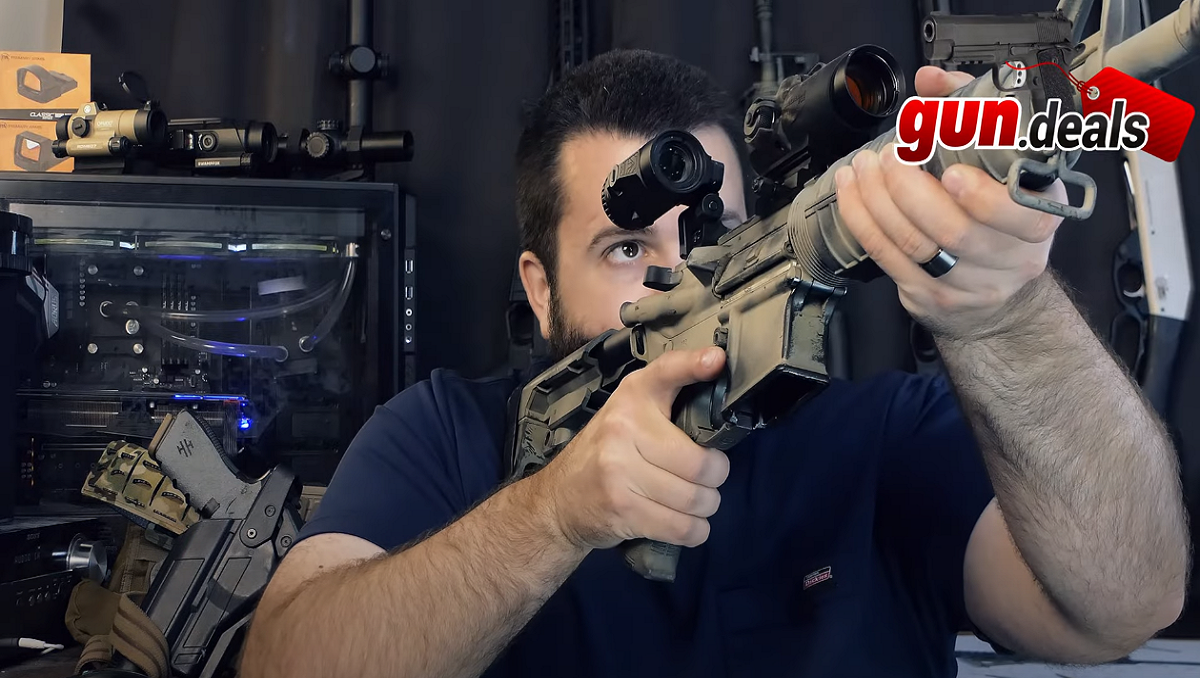
Getting into some of the other external features, it does come with a riser plate for a lower one-third co-witness, at least that’s what it feels like to me, and then if you don’t like that you can take off the riser plate and have kind of a low mount if you’re putting it on like an AK or something that already has a very low comb height so you don’t need a riser, but it is there.
Technically, they do have night vision settings, I have not checked out the night vision settings on the optic, but we’ll get into that in just a minute.
The mount itself is actually pretty decent, you get a fairly substantial crossbolt, not a particularly large clamping surface, but overall I was able to get 45-inch pounds on the crossbolt without issue, without coming close to stripping it out or anything else like that. The mount itself is fairly well designed, with the spacer, it’s fairly robust and it works fairly well, it did hold zero to an acceptable level.
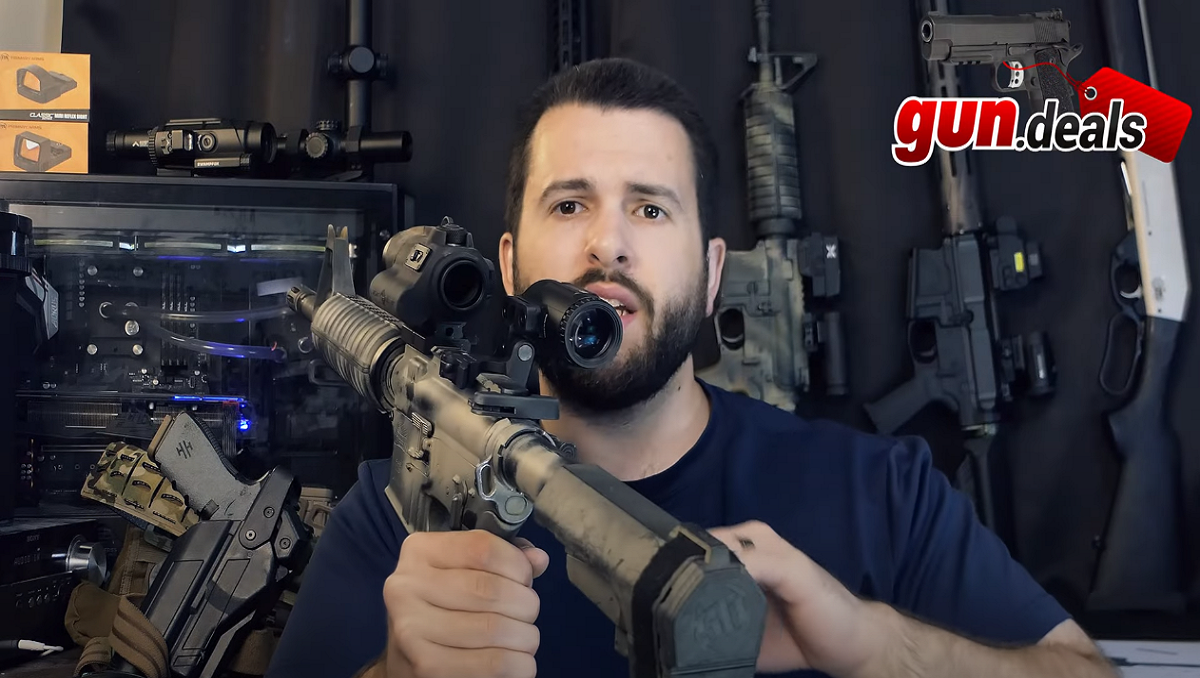
Getting into some of the other parts of the body, you might notice that this is a larger objective lens, that’s because this a 28mm red dot, so it is larger than your standard T1, T2 style micro red dots with a 20mm window, however, keep in mind that it does have a lot of bulk around the glass, so while, yes, you can see more through the optic, it does also occlude a lot more of your vision, having the much larger body style.
Really, other than that, the only couple things we need to talk about on the outside of the body is that most of it is covered in this very nice rubberized coating, which will protect it from scratches and take some of the impact from bumps, and so on and so forth. You do have capped windage and elevation, which are in ½ MOA increments, so it worked very well for me, I didn’t have any issues with that. They are captured as well with these little rubber grommets.
These look like aluminum protection, but this is really just part of that rubber overmold, so these aren’t like aluminum ridges that are going to really protect them like you’ll find on other optics, however, it is something and it does work, at least a little bit. We have our side-loading AA battery and then our two adjustments, we just have a PLUS arrow and an UP arrow, and a DOWN arrow for adjusting your brightness.
Getting into the glass quality and the reticle/emmiter on the Wolverine FSR, the glass quality is actually what I would consider to be very good for a red dot, it looks very natural, there’s almost no tint to it whatsoever, which is nice, so if you’re used to seeing like a very aggressive blue notch filter, this does have some minor color shift to it, but it is very, very minor, so overall, I would say the optical quality looks quite good.
On top of that, the doe itself gets very, very bright, and it is a fairly precise, simple 2 MOA dot, it looks very good to my eyes. I don’t have an astigmatism, so most dots look pretty good to me, and this one here is no different, even under magnification the dot itself looks very uniform, it looks very crisp, very precise for just a 2 MOA dot.
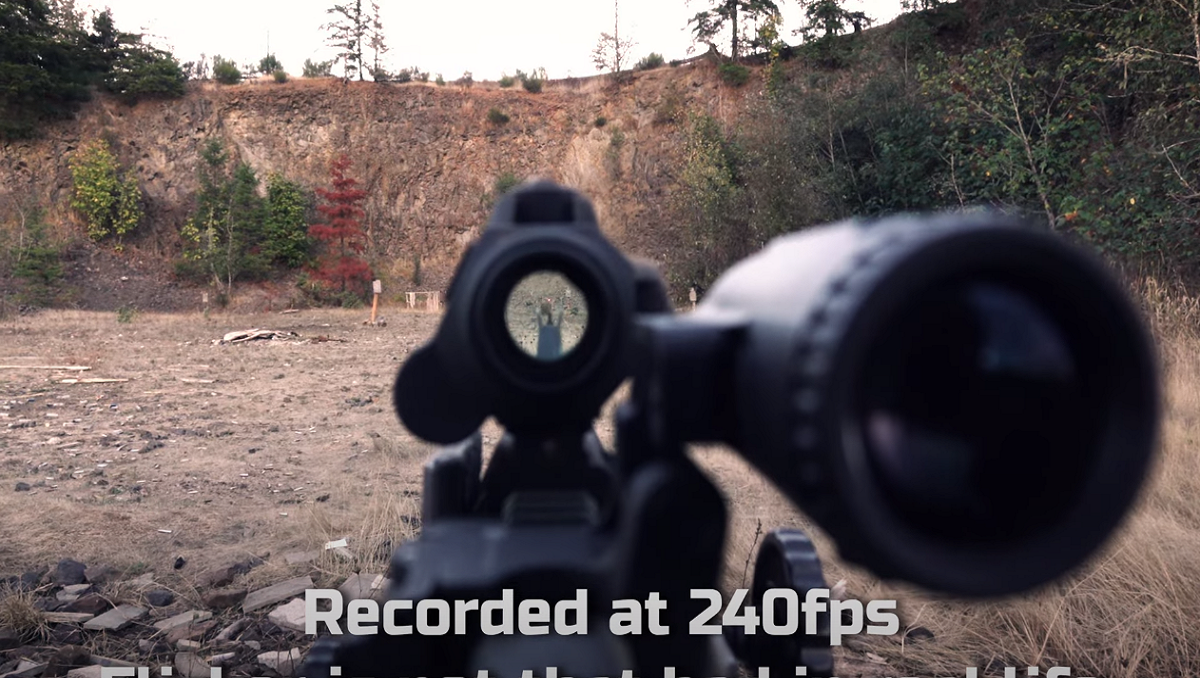
However, it does have an issue and this is kind of an issue that plagues some other optics as well is that the emitter refresh rate is tied to brightness level, so when you get up to the higher brightness level, especially the top two brightness levels, you have a very perfect refresh rate, very, very fast, and you’ll never notice it moving left or right, it looks like a very solid laser beam, but when you go on the lower brightness levels, anything outside of the top two, you’re gonna notice that refresh rate starts to get very choppy, and as you transition from target to target or just moving around in front of your face, you can see that the emitter is turning ON and OFF, 20, 30, 40 times a second, whatever it actually happens to be, but just know that it does have a noticeable refresh rate issue when you’re not towards the top end of the brightness level.

When I was outside in full sunlight usually I had it on like one setting below or maybe even two settings below max brightness, and it really wasn’t all that bad, but if you’re using it in like dusk or low light situations or something like that you are definitely going to notice that the refresh rate on the emitter is not all that great. If you’re in full daylight, if you’re already at the top end of the brightness levels, not really going to be that big issue to you.
Weight in the Wolverine FSR comes in at 12.3 ounces, which is pretty darn heavy for just a red dot, for an unmagnified optic. It’s not quite the heaviest red dot out there like the Romeo 8T is, but it is gonna be very heavy, cons compared to a lot of other smaller micro style red dots.
That, in and of itself, isn’t really that big of an issue, it’s just a red dot only gun or red dot plus magnifier and you don’t have a ton of other stuff on here, you’re probably not gonna be using like a pack or something up front with an optic that’s really not all that great for night vision use to begin with, but it is just something to note that it is a much bigger, heavier optic, and, unfortunately, it is missing the Motac auto-ON/auto-OFF technology that you’ll find with other optics, which is a little bit disappointing considering that it is in the same price category as a lot of other optics are, even in a similar size/weight.
So, if you we were going to compare it briefly to the SIG Romeo 7, which is an optic that I personally really like, comes in really about the same weight, this one here has a slightly larger 30mm objective lens, a 30mm window. This one here also has a less obtrusive body and still has the side-loading AA battery, right at about the same weight. Auto-ON/auto-OFF technology as well as the emitter is not tied to the brightness level so the emitter refresh rate is very good throughout the entire illumination range versus only good at the top end.
Wikiarms.com Search Engine Results
Want to see your products here? Click this
link.
See more results
for SIG Romeo7 on Wikiarms.com
Powered by Wikiarms.com
All that being said, when it comes to actual using the Wolverine FSR it was perfectly fine, very usable, the dot is very crisp, it gets more than bright enough, it looks good under magnification, the glass quality itself is good, there’s very little warping, there’s very little magnification, distortion, anything like that, it’s very bright, very easy to use in basically everything outside of the night vision use. It does just have a few little downsides, a few features that it’s missing when compared to other competitive options and it is gonna be on the heavier side of things.
So, if it had motion activation or auto-ON/auto-OFF technology that would be a huge plus and also allow it to save some of that battery life, and if the emitter was not tied to illumination settings so the refresh rate was very constant throughout the entire illumination range that would also be a large bonus as well.
Before we go any further I should mention that we did do some durability testing on the optic as well as zero retention test on the optic because it is built as durable optic, which, fortunately, it is, so we did three rounds at 100 yards on a steel target just to make sure that we were already on target, then dropped on top of the optic, then another three rounds to make sure that we were still on target, did another drop on the side of the optic, then did another three rounds at 100 yards just to make sure that zero had not experienced a gross shift.
Fortunately, there was basically no shift in zero whatsoever, the optic didn’t really take any damage either, a lot of the rubberized coating did get scuffed up and it is dirty now, but other than that the optic is in basically perfect condition, so as far as durability and zero retention goes, remember I have the crossbolt torque down to 45-inch pounds, which is perfectly fine. All of that seems to work together quite well.
When we compare it to other optics, in a similar price category, a similar size and weight, that sort of thing, it is just lacking in a few key features. It’s still not a bad optic, it was very easy to use, if you like bigger windows this does have a little bit of a bigger window.
Keep in mind that the body is pretty chunky and does obscure a lot of your other vision, so, yeah, it has a bigger window, the body itself is also kind of chunky, so there is definitely a trade-off there, but even still it was still a very easy optic to use, it was very easy to use in odd positions, unconventional shooting on the ground, around targets.
So, as far as shooting performance and durability on the optic goes, I’m actually perfectly happy with it, I think it did a very good job, it does all the red dot sort of things fairly well, it’s just a little bit behind the curve to more modern options, more feature-packed options, if you will. Not that it’s a bad red dot in any way, if you have one of these and it’s working perfectly fine for you, that’s all good, you don’t need to swap it out right away. If you’re looking at picking one of these up, it’s still a decent option, it’s maybe not the most ideal option on the market, still a good option, though if you pick one up, find one on a good deal, what have you, it is going to perform quite well, just know that there are some downsides to it.