
$1800 of Bad - L3 Atpial-C and Villain Weapon Systems Diffuser
Good morning, everyone, this is John with gun.deals. Today we're talking about the L3 Atpial-C, the civilian legal version of the PEQ 15 and the Villain Weapon Systems Diffuser. The civilian/gray market/fell of the truck and route is a very confusing and treacherous place. Imagine, if you will, a place where $4,000 will get you everything you've ever wanted, $2,000 will get you nothing, and $1,000 will get you halfway there somehow. And this is, unfortunately, in a dead zone of price and performance, and speaking of price, the Atpial-C, minus the Villain Weapons Diffuser is about $1,500 to $2,000 for an underpowered piece of plastic.
Full disclosure on the Atpial-C is that this was sent to me for review by a kind viewer of the channel. I have no relationship with the people putting these laser units out to the public. The laser aiming module was also sent to me with the Villain Weapon Systems Diffuser, which we will discuss towards the end.
Starting out with construction we have a mostly plastic body holding together, our IR Illuminator, IR laser, and red viz laser. My version is the tan model, though they come in black as well. At the back of the unit we have our battery tray for our CR123a battery, runtime is rated at about 6 IRs with dual IR illumination and IR laser, which is pretty good, though the power is low so the battery life should be good. Towards the middle of the unit we have our fire button, it's large, slightly recessed into the body, feels tactile enough. Modes of operation are pretty simple, press for momentary and double tap for constant.

Moving forward, we have two sets of turrets, one for adjusting the Illuminator so the lasers can be properly centered, and one set for actually adjusting your co-aligned viz and IR lasers. The advantage of having co-aligned lasers and a single set of turrets is that you can zero during the day with the viz laser and be ready to go at night with the IR laser. Also, having one set of turrets is just much nicer. At the front of the unit on the right hand side we have our two lasers and laser cover. The outboard laser is the viz laser, and the inboard is IR. The inboard laser is still about a half inch or so off center line so you can either set it up with a converging zero or a constant offset, but you won't be shooting far enough with this for that to ever matter much, and on the other side of the unit we have our IR Illuminator and diffuser cap.
The mount is a nice squared off crossbolt that clamps the plastic shell here rail. Do not over torque it, the plastic will snap with enough force. Total system weight is under 8 ounces, which isn't bad, but I would still like to not have a plastic body on a unit this expensive. Before we get to the performance let's talk about modes of operation. You really only have two modes that you're ever going to use, the viz laser to zero, which is one click counterclockwise, and then the dual IR laser and Illuminator. The unit might have markings for the high power modes, but those are just there to make you feel better about wasting 1,500 bucks. This is the civilian legal laser so you only get a 3M Illuminator with a fixed spread that measures out at 1 M at the brightest point to be legal.

Jumping into performance, it's really not great. The laser is appropriately powered, 99% of the time a civilian powered laser is great, it's really the Illuminator where you want or need that extra juice so that you can actually illuminate and engage targets. Depending on ambient lighting the Atpial-C has an optimistic 75-yard engagement range where you can positively identify engage and neutralize targets. That's 1,500 bucks for half the power of a Streamlight HL-X.
Let's talk about that diffuser and what it's good for. Villain Weapon Systems makes diffusers for all sorts of items, IR and otherwise, the point of a diffuser in this case is to add quick focus adjustment to whatever you install it onto, in this case the Atpial-C. VWS also has two different versions of their current iteration and a few different generations. This is a slightly older model, so updated models might have fixed some of the issues that I have.
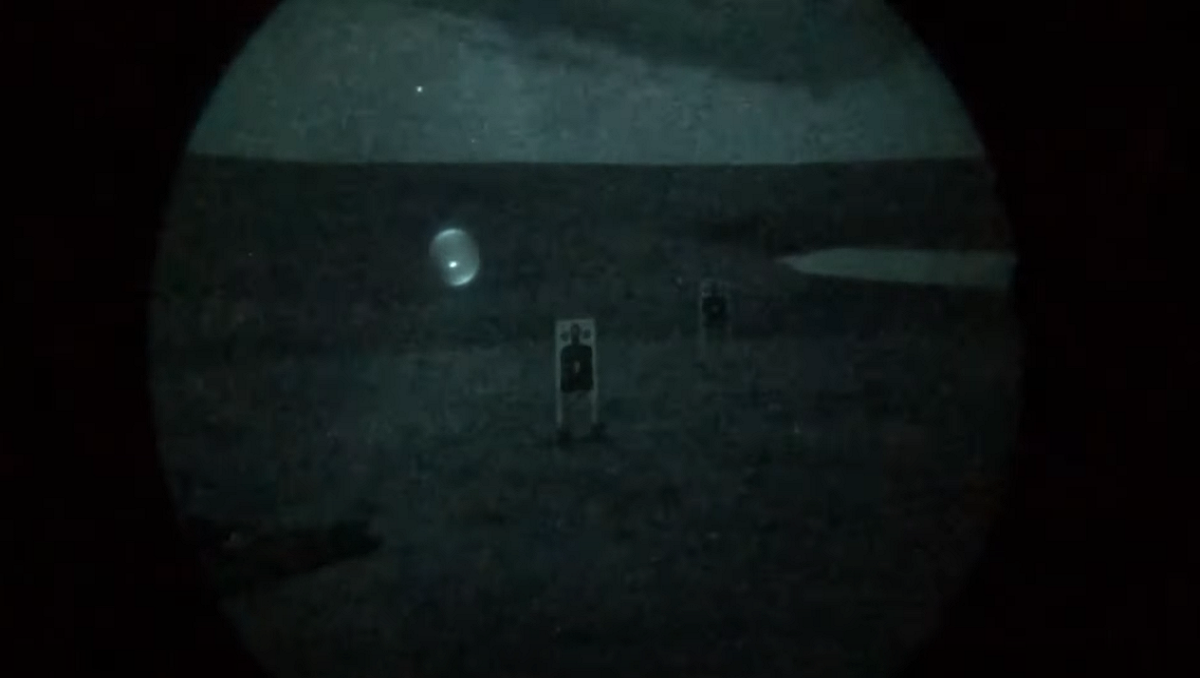
The cap that I have when activated is very tight, it takes about a 10ft beam at 50 yards down to about 3ft, so it's a very tight pattern, it's able to take whatever limited power you have and really focus that down into a theoretically more usable pattern. The light transmission on the cap itself is roughly 90%, keep in mind you are losing a little bit but hopefully in a more usable way. That sounds really nice on paper, unfortunately, most of the time it's the worst of both worlds. With the capped flipped out of the way it can be used to sweep define and illuminate targets up close, and effectively engage them without overexposing your tubes and washing out the image.
The downside is that in a mixed lighting environment it will not have the power to penetrate any sort of oppositional light, and it really is not going to provide good illumination past 50 yards, 75 is kind of pushing it. With the diffuser cap flipped on you get a super tight beam that will punch out to over 100 yards, maybe even 150 plus yards, on the top end in good conditions. The problem is that there's no margin for error at all. I have some targets set up here between 20 and 120 yards, and keep in mind that I know where they are because I set them up, but the beam is so small and focused that it's mostly useless for finding targets. Once you do find a target it's also pretty useless inside 100 yards because the beam is so tight that it ends out washing out your laser a little bit and it turns the whole area into a white blob of light with no definition whatsoever.
There is this dead zone of usability where between 75 and 100 yards neither setting works well, between 50 yards and in and 100 yards and out, maybe out to 150 or so, it only works okay. This is all going to be dependent on your night vision unit and your ambient lighting conditions. Keep in mind I'm using a cheap AGM 2 plus white phos unit with an approximately 1,400 to 1,600 FOM, so that is going to project a worse image of the units capabilities than if I had a 2500 plus FOM gen 3 unit with better glass.
Some other quirks of the VWS cap that I have is that it doesn't always flip into the correct position every time, so sometimes I would flip it on and it would not quite find where it's supposed to go on its own, meaning that the Illuminator beam would be off center by several feet cuz it didn't quite click in. You have a very tight beam pattern, so when it's off by a foot or two at 100 yards, that laser is either unusable or just around the edge of what's actually being illuminated.
Also the tension bands on my unit have loosened up a little bit over time, and sometimes they slip out of the channel. I hope that aspect has been improved in current models considering these are worth of $100 for a little bit of 3D printed plastic, but the lenses do work and give you a little bit of additional flexibility, but I'm really not sold on the Atpial-C, so getting something that makes something bad a little bit less bad for the low price of $2,000, it's really not an attractive option whatsoever. If you wanted this style of unit, unironically, the Holosun 321 is better. Still a bad value, in my opinion, I think there are better options coming soon and some more innovative options out there currently. Right now this is really a legacy/cloner unit that are just a waste of money for 99% of people.